


Vietnam is accelerating the formulation of a new policy framework for the upcoming period through a series of recently approved critical resolutions. The core focus of these policies is targeting double-digit economic growth, mastering core technologies, and standardizing workforce quality using rigorous evaluation benchmarks.
The National Assembly passed the Resolution on the 2027 socio-economic development plan with an approval rate of 93.40%1. Simultaneously, specialized ministries and sectors have concurrently rolled out action plans to create breakthroughs in digital transformation, master strategic technologies, and elevate the quality of human resources to serve the new development cycle2,3.

Photo: National Assembly of Vietnam – Vano111ru, CC BY-SA 4.0, via Wikimedia Commons.
Growth targets and technological breakthroughs according to the 2027 socio-economic development plan
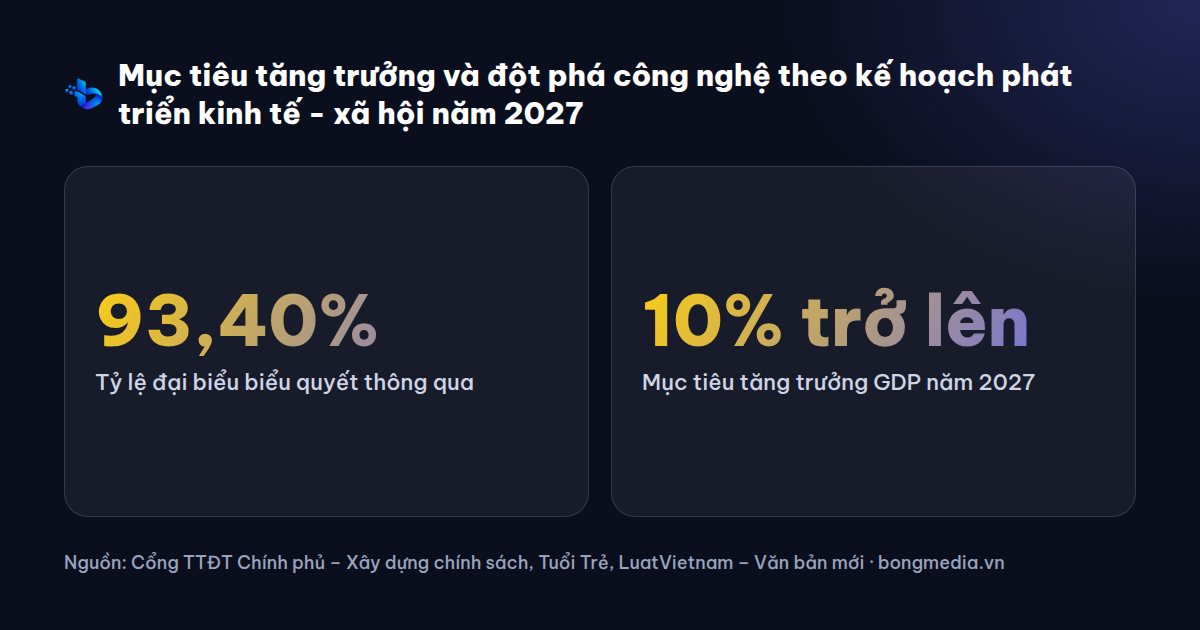
According to the Resolution approved by the National Assembly with 467 out of 469 delegates voting in favor, 2027 is positioned as an acceleration milestone to implement the Resolution of the 14th National Party Congress1. The core objective is to strive for a gross domestic product (FDI) growth rate of 10% or higher, coupled with inflation control and macroeconomic stability1.
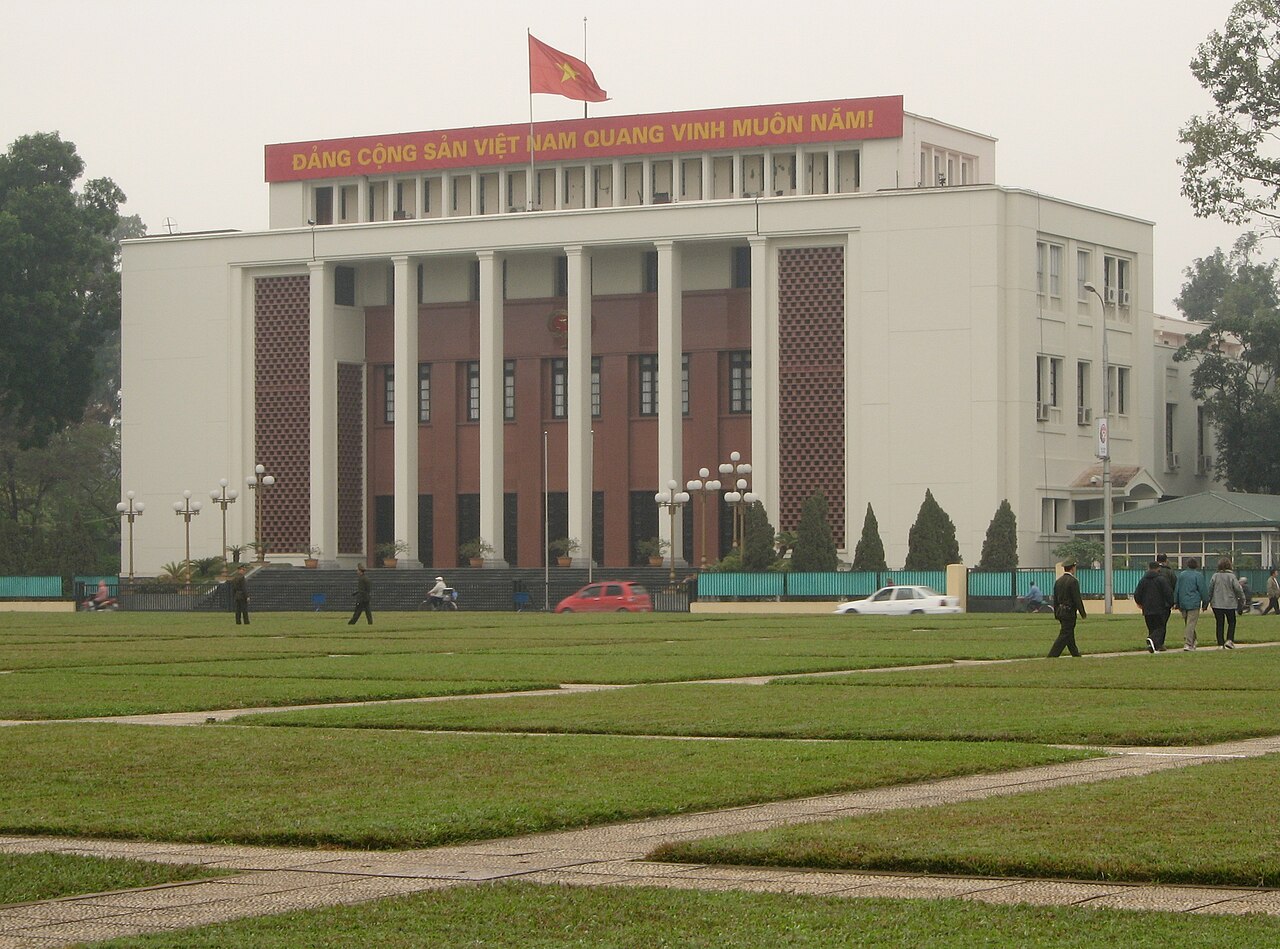
Photo: Ba Đình Hall 1 – Hector Garcia, CC BY-SA 2.0, via Wikimedia Commons.
To ensure driving forces for breakthroughs, the National Assembly identifies science, technology, innovation, and digital transformation as substantive breakthroughs1. The central tasks assigned to executive agencies are mastering strategic and core technologies and directly developing flagship technology product lines1.
Regarding financial policy and resource attraction, the Resolution requires the early implementation of expanding foreign investor ownership ratios in sectors that do not harm national security1. Simultaneously, the Government will implement solutions to encourage the foreign-invested enterprise (FDI) sector to use undistributed profits to reinvest in the Vietnamese market1.
Directions for digital infrastructure, semiconductors, and artificial intelligence
Detailing the direction to attract high-quality FDI, the Ministry of Education and Training issued Decision 3234/QĐ-BGDĐT dated November 6, 2026, to implement the Government's Resolution 280/NQ-CP3. This decision sets strict requirements for applying digital technology and cooperative training3.

Photo: Gallium Arsenide (GaAs) 2" wafer – La2O3, CC BY-SA 3.0, via Wikimedia Commons.
According to the assignment document, the education sector will transition to governance and administrative procedure processing related to direct investment on digital platforms and artificial intelligence (AI)3. The objective is to minimize compliance costs for foreign investors through decentralization and ex-post inspection mechanisms3.
The Ministry of Education and Training also prioritizes mobilizing both public and private investment flows to develop the education sector's digital infrastructure, research and development (R&D) centers, and laboratory systems3. The focus is on establishing specialized training facilities for semiconductor microchips, AI, and big data processing at affiliated universities3. The portfolio of priority projects for attracting foreign investment in the high-tech higher education sector will soon be widely announced3.
Standardizing healthcare human resources in the digital technology era
Besides information technology personnel, standards requirements for the healthcare sector have also risen markedly under the impact of digital technology2. At the 10th National Medical Education Conference taking place on November 7, Deputy Minister of Health Do Xuan Tuyen stated that AI and digital transformation are profoundly changing learning, teaching, and professional practice activities, making the elevation of healthcare workforce training quality an urgent requirement that demands educational institutions to review and benchmark output standards against professional competency requirements2.

Photo: Students in theTeaching laboratory, Medical School, Yakusu Wellcome L0039121 – Stanley Browne, CC BY 4.0, via Wikimedia Commons.
Mr. Le Quang Cuong, Chairman of the Vietnam Medical Education Association, emphasized that the training model must completely shift from imparting theoretical knowledge to competency-based practical assessment relying on output standards2. According to Mr. Nguyen Thanh Hoi, General Director of Phenikaa University Hospital cum Rector of the Phenikaa Faculty of Medicine and Pharmacy, medical training institutions must integrate clinical case resolution closely tied to reality instead of teaching isolated subjects2.
Director of the Department of Science, Technology and Training (Ministry of Health) Nguyen Ngo Quang announced the roadmap: the first national medical examination and treatment professional competency evaluation test will be organized in March and December 20272. The 2027 examination applies to general practitioners, preventive medicine doctors, odontostomatologists, traditional medicine doctors, and resident doctors, including computer-based theoretical exams and practical assessments2. By 2028, the evaluation test will expand to nurses, medical assistants, and midwives before fully covering all medical professional titles by 20292.
Vizy's take
According to Vizy, the National Assembly setting a GDP growth target of 10% or higher in 2027 indicates immense pressure regarding the expansion of new economic spaces. As traditional growth margins gradually saturate, science, technology, and digital transformation are no longer encouraging orientations, but have become mandatory tools to elevate total factor productivity.
Vizy suggests that policy coordination from the macro level down to the education and healthcare sectors demonstrates a methodical resource preparation strategy. Concentrating capital into fields such as semiconductors and artificial intelligence, alongside digitizing the nationwide medical practice competency examination from 2027, could create a new competitive standard for Vietnam's high-tech labor market in the coming years.
Sources
- Cổng TTĐT Chính phủ – Xây dựng chính sách – Quốc hội thông qua Nghị quyết về kế hoạch phát triển kinh tế - xã hội năm 2027 (2026-11-07)
- Tuổi Trẻ – Từ năm 2027, bác sĩ phải qua kỳ kiểm tra năng lực hành nghề toàn quốc (2026-11-07)
- LuatVietnam – Văn bản mới – Quyết định 3234/QĐ-BGDĐT của Bộ Giáo dục và Đào tạo ban hành Kế hoạch thực hiện Nghị quyết 280/NQ-CP ngày 22/9/2026 của Chính phủ ban hành Kế hoạch hành động của Chính phủ thực hiện Nghị quyết 10-NQ/TW ngày 08/6/2026 của Bộ Chính trị về phát triển kinh tế có vốn đầu tư nước ngoài (Bảy, 07 T)
Compiled and analysed by Vizy from the sources above and reviewed by a Bống Media editor before publication. "Vizy's take" is the author's own opinion. For information only, not investment advice.
FAQ
What is the economic growth target for 2027 passed by the National Assembly?
The National Assembly set a target to strive for GDP growth of 10% or higher, coupled with macroeconomic stabilization and the mastery of strategic technologies.
When does the national medical practice competency evaluation roadmap begin?
The evaluation exam begins deployment for physician titles in March and December 2027, expanding to nurses, medical assistants, and midwives in 2028, and the remaining titles in 2029.
What technology fields does the Ministry of Education and Training prioritize for investment attraction?
The Ministry prioritizes investing in digital infrastructure, laboratories, and specialized human resource training facilities for semiconductor microchip technology, artificial intelligence, and data.